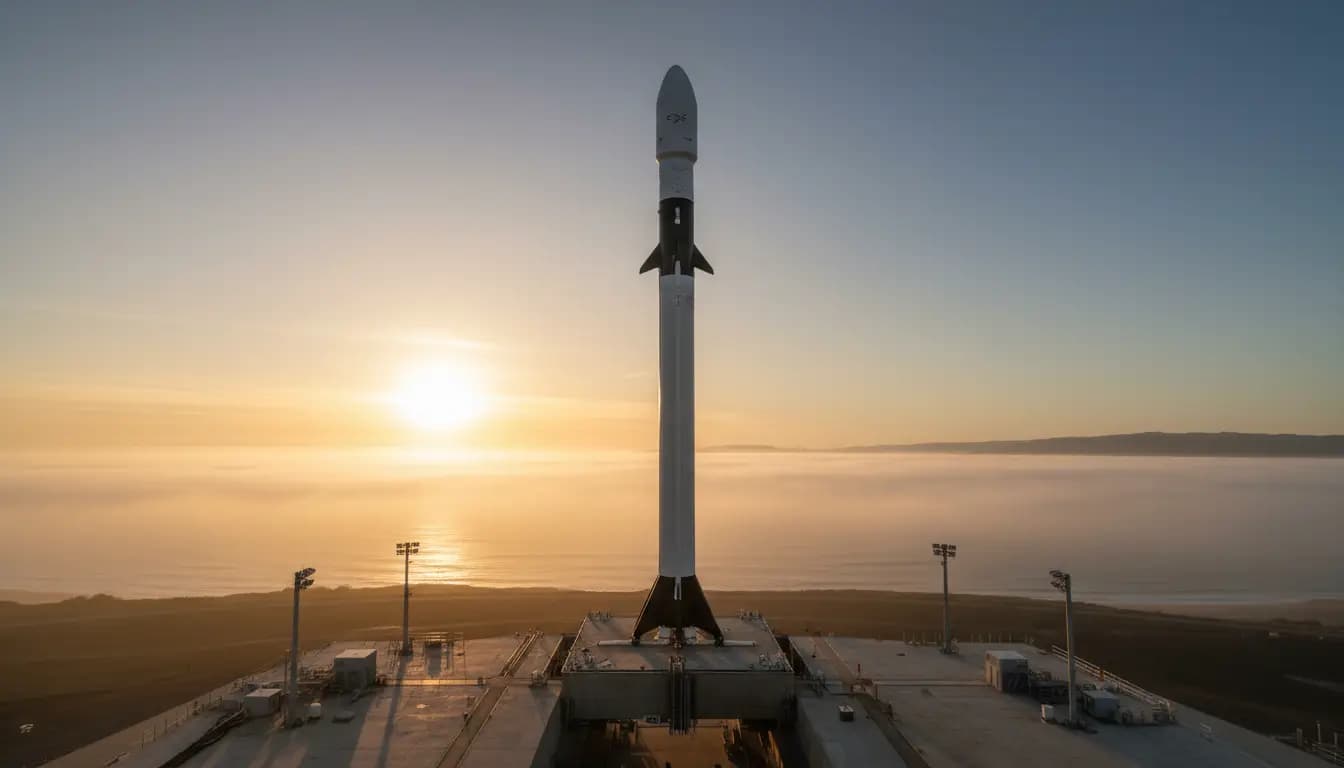
Falcon 9 Set to Launch Rivada 11 on June 29
Everything you need to know about the upcoming SpaceX Falcon 9 launch from Vandenberg Space Force Base, targeting Monday, June 29, 2026.
SpaceX is preparing for another spectacular rocket launch from Vandenberg Space Force Base this Monday, June 29, as the aerospace company sends 24 more satellites into orbit for Rivada's growing internet constellation. The Falcon 9 Block 5 rocket will thunder skyward from Space Launch Complex 4E, continuing the ambitious effort to provide global broadband coverage from space.
This Rivada 11 mission represents the latest chapter in the new space economy unfolding right here on California's Central Coast. Rivada Space Networks has been steadily building its satellite constellation to deliver high-speed internet access to underserved regions around the world, and each successful launch brings that vision closer to reality. The 24 satellites aboard Monday's flight will join hundreds of others already circling Earth in polar orbit, creating a sophisticated network capable of beaming internet connectivity to remote corners of the globe.
Falcon 9 rockets have become a familiar sight streaking across Central Coast skies, but the spectacle never gets old. The rocket's nine Merlin engines will generate over 1.7 million pounds of thrust at liftoff, propelling the vehicle and its precious cargo toward the polar orbit required for Rivada's constellation. As has become routine for SpaceX, the company will attempt to recover the first stage booster, either landing it back at Vandenberg or on one of their autonomous drone ships positioned offshore.
Monday's launch promises exceptional viewing opportunities for residents across the 805 region. Weather permitting, the rocket should be visible from Santa Barbara to San Luis Obispo County and potentially even farther inland. The polar trajectory means the Falcon 9 will arc southward over the Pacific Ocean, creating a brilliant artificial streak of light against the sky that can be seen for hundreds of miles.
Optimal viewing conditions depend on several factors including weather, time of launch, and your location relative to the flight path. Beach communities typically offer unobstructed western views, while higher elevation spots inland can provide panoramic perspectives of the rocket's journey. For those seeking the perfect vantage point, detailed recommendations for prime viewing locations throughout the Central Coast can be found at 805.life/launches/where-to-watch.
Beyond the visual spectacle, Monday's mission underscores Vandenberg's growing importance as America's premier polar launch facility. The base's unique geographic position makes it ideal for satellites requiring north-south orbits, and SpaceX has dramatically increased the launch tempo from the historic California facility. Each successful mission not only advances commercial space ventures but also brings significant economic activity to the Central Coast, cementing the region's role in humanity's expanding presence beyond Earth.
Related Launches

More Articles
Falcon 9 Set to Launch USSF-385 on September 26
Everything you need to know about the upcoming SpaceX Falcon 9 launch from Vandenberg Space Force Base, targeting Saturday, September 26, 2026.
Launches Sep 26, 2026
Falcon 9 Set to Launch SDA Tranche 1 Transport Layer A on October 5
Everything you need to know about the upcoming SpaceX Falcon 9 launch from Vandenberg Space Force Base, targeting Monday, October 5, 2026.
Launches Oct 5, 2026
Falcon 9 Set to Launch Transporter 18 (Dedicated SSO Rideshare) on October 1
Everything you need to know about the upcoming SpaceX Falcon 9 launch from Vandenberg Space Force Base, targeting Thursday, October 1, 2026.
Launches Oct 1, 2026