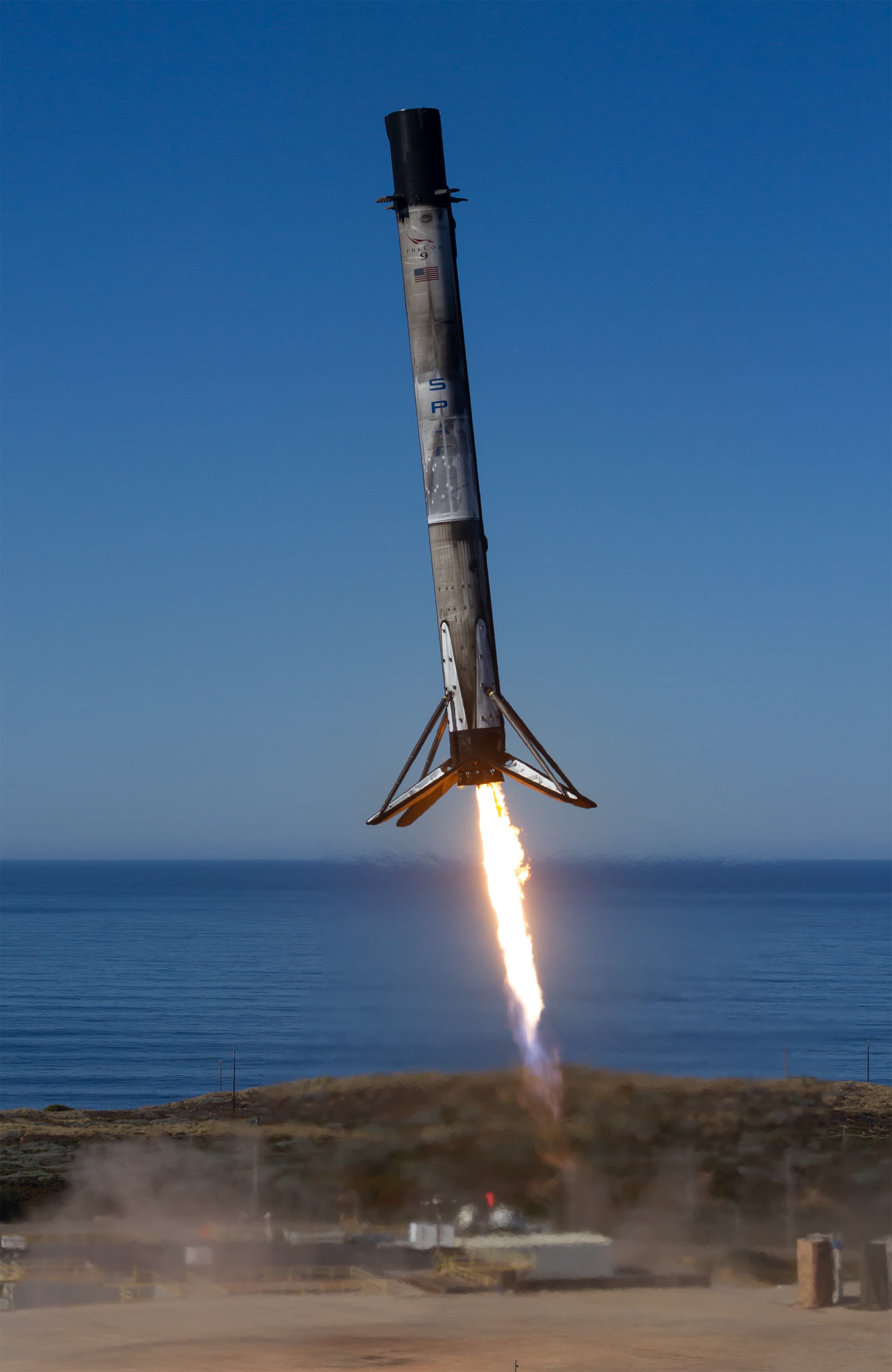
B1088
With 14 flights and a perfect landing record, SpaceX's B1088 has become one of the most-flown Falcon 9 boosters launching from the Central Coast.
Total flights
19
Vandenberg
7
Landings
19/19
Since
2024
At a Glance
B1088 is a Falcon 9 Block 5 booster built by SpaceX, currently active and with a spotless record: 14 flights, 14 successful landings. The booster first flew in late November 2024 and has since become one of the company's most reliable workhorses, cycling through missions at the rapid cadence that defines modern launch operations. It belongs to the Block 5 variant, the final and most refined iteration of the Falcon 9 first stage, designed for dozens of reuses with minimal refurbishment between flights.
Of those 14 missions, two have launched from Vandenberg Space Force Base on the Central Coast, both from Space Launch Complex 4E. The booster remains active as of its most recent flight on March 17, 2026, with another Vandenberg mission on the manifest for late April. For residents of Lompoc, Santa Barbara, and points north, B1088 has become a familiar sight rising over the Pacific in the early morning or evening twilight, a streak of orange flame trailing back toward the ocean as the booster separates and begins its descent.
The Career of B1088
The booster's career began elsewhere, logging a dozen flights before it ever saw the fog-draped hills of Vandenberg. By the time B1088 arrived at SLC-4E for its first Central Coast mission on March 17, 2026, it was already a veteran, flight number 14 in a roster that had built trust through consistency. That mission carried Starlink Group 17-24 into low Earth orbit, one of the dozens of batches SpaceX has launched to expand its broadband constellation. The flight went off without incident, the booster separating cleanly and descending to the droneship waiting somewhere west of Point Conception.
Less than six weeks later, B1088 returned to Vandenberg for what is currently listed as flight number 15, the Starlink Group 17-16 mission scheduled for April 25, 2026. The pace is typical for a proven booster in the Starlink rotation. SpaceX has refined its reuse process to the point where a single first stage can launch, land, be refurbished, and launch again within a matter of weeks. B1088 exemplifies that rhythm, a piece of hardware cycling through the same launch complex, the same payload fairing integration facility, the same pre-flight checklist, over and over.
Vandenberg is one of two primary homes for Falcon 9 on the West Coast, the other being Cape Canaveral and Kennedy Space Center in Florida. Boosters rotate between coasts depending on mission requirements, manifest scheduling, and logistics. B1088's presence at Vandenberg reflects both the booster's versatility and the steady demand for polar and sun-synchronous orbit launches that only the Central Coast can provide. The trajectory out of SLC-4E heads south over the Pacific, a flight path that avoids populated areas and allows payloads to reach inclinations unavailable from Florida's eastward-facing pads.
Vandenberg Missions
On March 17, 2026, B1088 lifted off from SLC-4E carrying Starlink Group 17-24, its 14th flight overall and first from Vandenberg. The mission succeeded, delivering another batch of internet satellites into their designated orbit. The April 25, 2026 mission, Starlink Group 17-16, marks the booster's second Vandenberg appearance and 15th total flight, continuing the pattern of rapid reuse that has become the backbone of SpaceX's launch cadence.
Landings and Recovery
Most Falcon 9 missions out of Vandenberg conclude with the booster descending onto the droneship Of Course I Still Love You, stationed in the Pacific several hundred miles downrange. The autonomous vessel positions itself along the booster's return trajectory, waiting for the stage to execute its reentry burn, flip vertical, and descend under the control of a single Merlin engine and four landing legs. Weather permitting, the booster touches down on the deck within minutes of liftoff, secured by technicians before the long tow back to port. The droneship landings are silent from shore, the booster too far out to sea for the sonic boom to reach land.
A smaller number of Vandenberg missions opt for return-to-launch-site landings at Landing Zone 4, the concrete pad just south of SLC-4E. These missions carry lighter payloads, leaving enough propellant margin for the booster to reverse course and fly back to the base. When a booster lands at LZ-4, the twin sonic booms of reentry roll across Lompoc, sometimes rattling windows as far north as Santa Maria. It is a sound familiar to anyone who has lived near Vandenberg for more than a few months, a double crack that announces the booster's return before the engine roar becomes audible. B1088's Vandenberg flights to date have not included an LZ-4 landing, both missions concluding instead on the droneship.
Still in the Game
As of early spring 2026, B1088 remains active, with at least one more Vandenberg mission on the schedule and likely more to follow. The booster has compiled a flawless landing record across 14 flights, a testament to both the maturity of the Block 5 design and the operations tempo that SpaceX has sustained for years now. For those of us watching from the 805, it represents the routine made remarkable: the same piece of hardware, launched and recovered again and again, turning what was once science fiction into infrastructure. The booster will keep flying until it no longer can, and when it finally retires, another will take its place on the pad at SLC-4E, ready to light up the Central Coast sky once more.
Vandenberg Missions Flown by B1088
- #8
Falcon 9 Block 5 | Starlink Group 15-25
Oct 10, 2026Space Launch Complex 4E - #7
Falcon 9 Block 5 | Starlink Group 15-24
Sep 6, 2026Space Launch Complex 4ESuccess - #6
Falcon 9 Block 5 | USSF-366
Aug 15, 2026Space Launch Complex 4ESuccess - #5
Falcon 9 Block 5 | Starlink Group 17-40
Jun 28, 2026Space Launch Complex 4ESuccess - #4
Falcon 9 Block 5 | Starlink Group 17-47
Jun 3, 2026Space Launch Complex 4ESuccess - #3
Falcon 9 Block 5 | Starlink Group 17-16
Apr 26, 2026Space Launch Complex 4ESuccess - #2
Falcon 9 Block 5 | Starlink Group 17-24
Mar 16, 2026Space Launch Complex 4ESuccess - #1
Falcon 9 Block 5 | Starlink Group 17-33
Feb 7, 2026Space Launch Complex 4ESuccess
Frequently Asked
At a Glance
Serial
B1088
Configuration
Falcon 9 Block 5
Manufacturer
SpaceX
First flight
Nov 30, 2024
Most recent
Sep 6, 2026
Key Facts
- 14 total flights since November 2024
- 14 successful landings out of 14 attempts
- 2 Vandenberg launches from SLC-4E
- Active status as of April 2026
- Falcon 9 Block 5 configuration
- First flew November 30, 2024