Discovering Channel Islands: A Central Coast Place Guide
805.life Editorial Team
Researched and reviewed by our Central Coast editorial team
July 3, 2026
Twenty-seven miles offshore, the Channel Islands archipelago sits suspended in time — a wilderness of kelp forests, sea caves, and endemic foxes that earns its 'Galápagos of California' nickname honestly. Summer is the season to go, when the Pacific lays down and the islands reveal their raw, elemental character.
California's Galápagos: An Archipelago Apart
You feel the shift before you see it. About an hour into the crossing, the mainland haze thins and the water changes color — from coastal gray to a luminous, almost tropical blue. Then the islands materialize on the horizon, their tan and rust-colored cliffs rising from the sea like the spine of some ancient, submerged mountain range. It's a striking moment, and it happens every single time you make this trip. The Channel Islands have a way of making you forget that Greater Los Angeles — seventeen million people, twelve lanes of freeway, the whole asphalt machine — is barely sixty miles east. Out here, that world doesn't just feel far. It feels fictional.
Five islands comprise Channel Islands National Park: Anacapa, Santa Cruz, Santa Rosa, San Miguel, and Santa Barbara. They've never been connected to the mainland, even during the last Ice Age when sea levels dropped dramatically. That isolation — tens of thousands of years of it — produced an ecosystem found nowhere else on the planet. Over 150 species of plants and animals are endemic, meaning they exist here and only here. The most famous is the island fox, a housecat-sized canid that evolved separately on each island. That fox is also the reason many people make their first trip. It's a small, big-eared animal with an almost absurdly calm demeanor, and during summer, you have a solid chance of spotting one trotting along a trail.
Tip: Bring binoculars. Summer brings breeding colonies of seabirds, and the rocky shores host elephant seals and California sea lions. A decent pair of 8x42s will transform your visit.
Getting There: The Crossing Is Part of the Experience
There are no bridges, no causeways, and no luxury ferries to the Channel Islands. Access is by concessionaire boat through Island Packers, operating out of Ventura Harbor and also Oxnard for select trips. Island Packers is the National Park Service's official boat operator, and they've been running these waters since 1968. Reservations are essential, especially in July and August. The crossing to Anacapa takes roughly an hour; Santa Cruz is about ninety minutes. San Miguel and Santa Rosa demand longer commitments — and permits. The boats are working vessels, not cruise ships. Expect outdoor seating, salt spray, and the smell of diesel mixed with kelp. Dress in layers and bring a windproof shell.
Summer is the easiest window for the crossing. The Pacific calms somewhat, with morning winds settling by midday. You'll still feel the swell, but the likelihood of a smooth ride increases dramatically compared to spring. Those prone to seasickness should take medication before boarding — once you're on the water, it's too late.
Tip: Book your Island Packers trip at least three weeks ahead for summer. The morning departures have better conditions and more time on the island.
Anacapa: Closest, Dramatic, Accessible
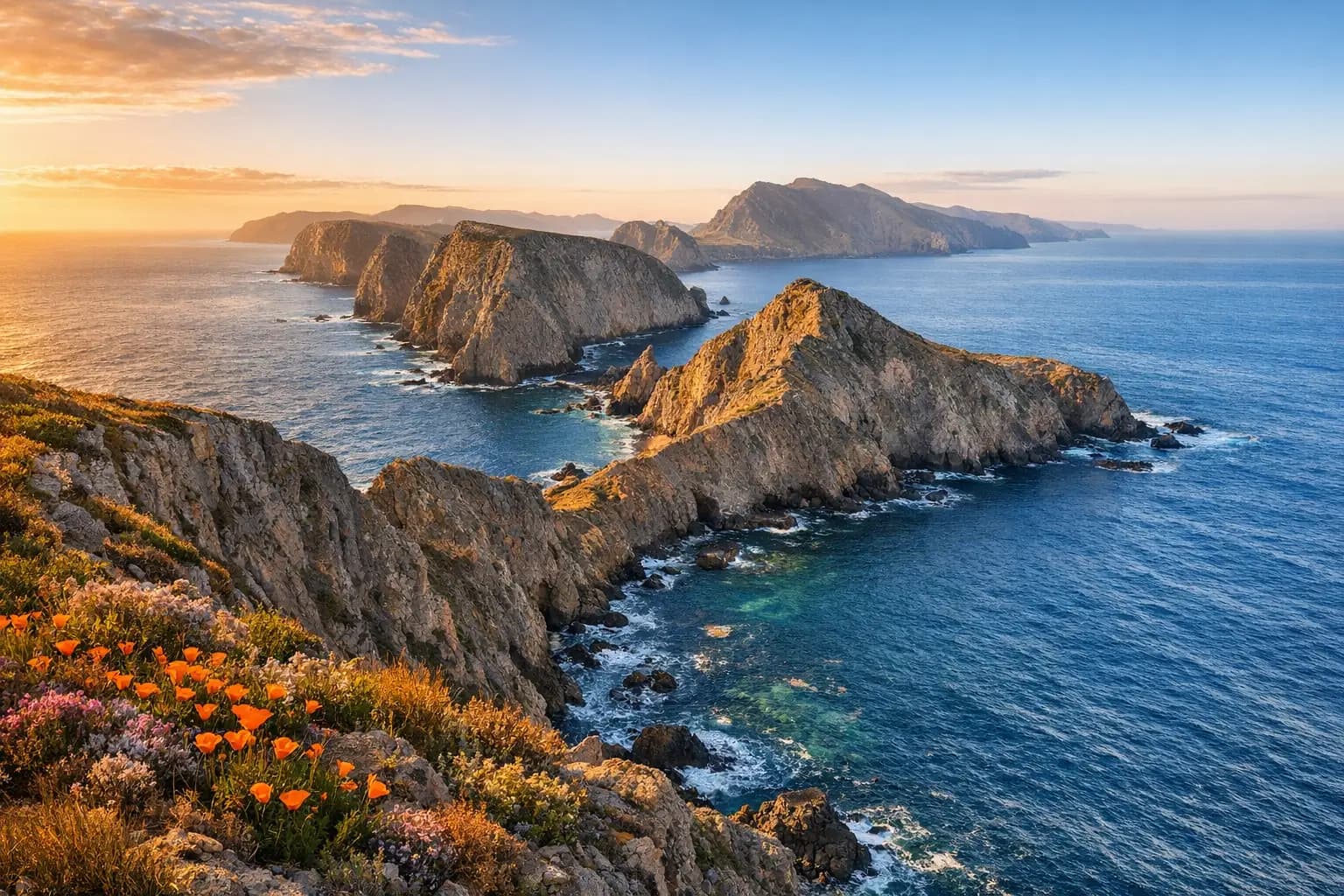
Anacapa is the nearest island, a slender ribbon of volcanic rock broken into three islets. It's where most first-time visitors land. The dock at East Anacapa sits in a narrow cove, and from there a steep staircase — 157 steps, to be exact — carries you to the island's plateau. The trail system is short but visually stunning. The iconic Anacapa lighthouse, built in 1932, sits at the eastern tip. Inspiration Point offers one of the most photographed views in the national park system — a razor-thin landform curling into the channel with the other islets arrayed behind it. It's a place that invites quiet. You'll hear wind, gulls, and the low conversation of the sea against rock.
In summer, Anacapa's coreopsis groves are dormant, their bare branches giving a sculptural, almost skeletal look. It's striking in a way that challenges the expected lushness of a California summer. The bloom comes in spring — golden explosions that warrant a separate trip. But summer brings the seabirds: western gulls, cormorants, and the occasional pelican riding thermals above the cliffs.
Tip: Anacapa has no fresh water. Bring everything you need — at least one gallon per person for a day trip.
Santa Cruz: The Big Island With Kelp Forests
Santa Cruz is the largest island in the chain and offers the most variety. Over 60,000 acres of land, with a high point at El Diablo Peak at 2,434 feet, it's a massive, multi-faceted place. You can do a day trip or camp overnight at Scorpion Ranch, a historic property that once ran thousands of sheep. Today, the campground sits in a eucalyptus-shaded canyon, a fifteen-minute walk from the dock. It's the most popular campground in the park for good reason — level sites, wind protection, and a genuinely remarkable island atmosphere.
Summer snorkeling at Scorpion Anchorage is exceptional. The kelp forest begins just yards from shore, and once you're in, you're floating through columns of amber and emerald light. Garibaldi — California's state marine fish — are everywhere, electric orange against the blue. Sea lions are common and curious. They'll swim alongside you, twisting and blowing bubbles. The water temperature hovers around 65-68 degrees in late summer; a 3mm or even 4mm wetsuit makes a big difference if you're planning to stay in longer than ten minutes.
Hiking options fan out from Scorpion Ranch. Cavern Point is a moderate climb that delivers sweeping ocean views and is a reliable spot for watching harbor seals. Potato Harbor — a five-mile round trip from Scorpion Ranch — takes you across the island's rolling back, through patches of native grassland where island foxes hunt by day. The trail is exposed; bring a wide-brimmed hat and start early.
Tip: Reserve a sea kayak through Channel Islands Kayak Center in advance. Guided tours launch from Scorpion Anchorage and provide helmets, wetsuits, and instruction for paddling into the sea caves.
Camping Under Dark Skies
Overnight camping is the best way to experience the islands, and summer is when it shines. Channel Islands National Park has some of the darkest skies in Southern California. There are no electric lights on the islands — not at the campgrounds, not on the trails. By 10 p.m., the Milky Way is a bright, textured band stretching horizon to horizon. It's the kind of sky that makes mainland visitors stand outside their tents and simply look up.
The campgrounds are primitive. Pit toilets, no running water on Anacapa, and limited water on Santa Cruz. Sites must be reserved through Recreation.gov, and summer weekends fill months ahead. The cost is low — around $15 per night — but the experience is rare. You'll wake to seabirds at dawn, the smell of salt and sage, and a quiet so deep it takes a moment to process.
Tip: Pack all food in sealed containers — island foxes are bold and opportunistic. They will open packs and zip bags. Hard-sided bins are provided at Scorpion Ranch campground.
Santa Rosa and San Miguel: The Remote Ones
Santa Rosa and San Miguel demand more planning. The crossings are longer — over two hours — and the weather windows are narrower. But the reward is a degree of solitude that feels almost mythological. Santa Rosa's Torrey Pines grove is one of two remaining native populations of that rare pine, the other being at Torrey Pines State Reserve in San Diego. The island's Cloud Forest hike takes you into a rare fog-dependent ecosystem found only at the highest elevations. San Miguel, the westernmost island, is exposed and wind-scoured. Point Bennett, on its western tip, hosts one of the largest pinniped rookeries in the world — over 100,000 animals during peak season. It's a raw, elemental place that rewards preparation.
Both islands have limited services and require naturalist accompaniment or permits for certain areas. Check current conditions through the National Park Service visitor center in Ventura before booking your trip. San Miguel sometimes closes during marine mammal pupping season.
When To Go: The Summer Window
Summer is the prime season, and for good reason. The ocean calms, the fog often burns off by afternoon, and the wildlife is active. Blue and humpback whales are commonly seen during crossings from June through September. Island Packers runs dedicated whale-watching trips alongside island landings, and spotting a blue whale — the largest animal ever to exist — from the deck of a boat is an experience that recalibrates your sense of scale.
There's an ideal rhythm to a Channel Islands summer day. You leave Ventura Harbor in the cool early morning, the sun rising behind you. The crossing takes an hour or more, during which you'll see dolphins, maybe whales, certainly pelicans. You arrive at the island and spend the day hiking, snorkeling, or kayaking. In late afternoon, you board the boat for the return, sun-warm and salt-sticky, the islands shrinking behind you. It's a full day, and you'll sleep deeply that night.
Tip: Visit the Channel Islands National Park visitor center at Ventura Harbor before your trip. The natural history exhibits provide context that enriches every minute on the islands, and rangers can brief you on current conditions.
A Place That Changes You
The Channel Islands are not a resort. There are no restaurants, no shops, no cell service, no Wi-Fi. What there is — in abundance — is a landscape that feels authentically wild in a way most of California no longer does. You'll step off the boat and immediately notice the silence. Not true silence — there's wind, waves, birdsong — but the absence of human noise. It's disorienting at first. Then it becomes the whole point.
These islands represent what the Central Coast looked like before agriculture, before development, before the freeways. They're a window into a California that mostly vanished a century ago. And the fact that they're accessible — a short boat ride from Ventura, open to anyone willing to plan ahead and pack carefully — is a gift. Go in summer. Go early. Bring water and patience. You'll come back changed.
City
Channel IslandsGuide Type
destination-guide
Category
Travel
AI-curated guide based on local business data
Explore Channel Islands