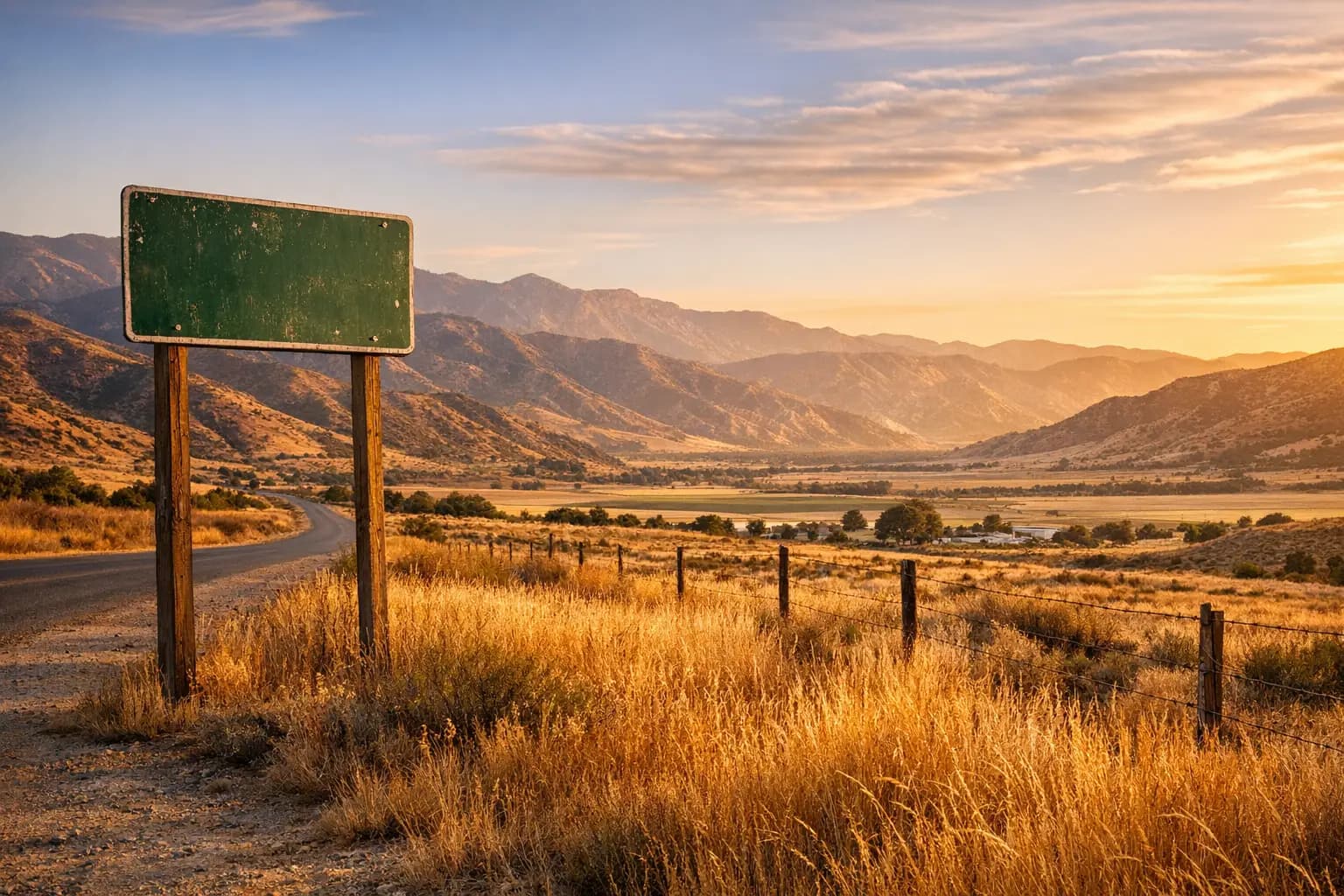
Discovering New Cuyama: California's Last Frontier Valley
805.life Editorial Team
Researched and reviewed by our Central Coast editorial team
July 3, 2026
Where Highway 166 cuts through golden grassland and the Los Padres backcountry rises like a wall, New Cuyama waits in stubborn, beautiful isolation. This is the Central Coast's most remote community — a place where silence has weight, stars feel close enough to touch, and the Old West never quite ended.
The Road In
There is no gentle way to arrive in New Cuyama. You commit. From Santa Maria, you point your car east on Highway 166 and watch the suburban landscape peel away within minutes — first the strip malls, then the orchards, then everything. The Cuyama Valley opens ahead like a sentence left unfinished, bracketed north and south by the Caliente and Sierra Madre mountain ranges. Cell service thins and then disappears entirely around the Tepusquet Road junction, and that's the moment most people feel it: the particular silence of a place that has no interest in being convenient. The drive from the coast takes about an hour and fifteen minutes, but you'll cross a psychological border long before you cross the county line. From Bakersfield, it's a roughly ninety-minute drive west through equally dramatic terrain — the mountains close in around you before spitting you out into that same improbable valley.
Tip: Download offline maps before you lose service. The last reliable cell signal is near the Santa Maria airport area heading east; it doesn't return until you're well into the valley near the Cuyama Valley High School area.
A Valley Shaped by Water and Want
The Cuyama River is the reason anything exists here at all. It's not much to look at in summer — a silver thread winding through saltbush and cottonwood — but this waterway carved the valley and sustained the Chumash people for thousands of years before any map existed. The name itself is Chumash, likely derived from a word meaning 'clam' or referring to a medicinal plant native to the drainage. When Spanish explorers passed through in the late eighteenth century, they found villages along the river's course. By the 1880s, Anglo ranchers had claimed the land for cattle, and the valley settled into the rhythm it maintains today: seasonal, spare, and deeply tied to what the ground will produce. Oil arrived in the mid-twentieth century and brought a brief boom — you can still see pump jacks nodding in the distance — but the population never grew much beyond a few hundred. That's not failure. That's a place that understood its own scale.
What 'New' Means
The 'New' in New Cuyama refers to a relocation that happened in 1952, when the original settlement of Cuyama — sitting a few miles east along the river — was moved to its current location along the newly paved Highway 166. It was a practical decision: the highway brought traffic, and traffic meant a gas station might survive. What grew from that decision is less a town than a gathering: a cluster of homes, a school, a community center, and a few buildings that face the highway as if still expecting company. The old Cuyama site, sometimes called Cuyama Old Town, still exists in fragments — foundations, a cemetery, the kind of places that reward those willing to pull over and walk. But the heart of the valley beats at the new location, where the architecture hasn't changed much since the Eisenhower administration.
Summer on the High Grassland
Summer here is not the Central Coast summer you might picture. At roughly 3,000 feet elevation, the Cuyama Valley bakes. Daytime temperatures routinely exceed 95 degrees from June through September, and the dry heat feels more like inland Kern County than coastal Santa Barbara County — which makes sense, because geographically and culturally, you're closer to the former. The grasslands turn a pale gold that's almost white under the midday sun, and the light is so clear it feels aggressive. But mornings are magic: 6 AM brings cool air, maybe 55 degrees, and long shadows raking east from the ridgelines. If you're going to do anything physical — hike, walk the back roads, explore — do it before 9 AM or after 7 PM. The valley sits in a rain shadow, so summer thunderstorms are rare but not impossible; when they come, they arrive with theatrical violence and leave within an hour, and the smell of wet sage is unlike anything on the coast.
Tip: Carry at least one gallon of water per person in your vehicle, even for a day trip. There are long stretches of Highway 166 with no services, and summer breakdowns here are genuinely dangerous.
The Los Padres Backdoor
What makes New Cuyama extraordinary — beyond its isolation — is its position as the back door to the Los Padres National Forest. The Sierra Madre Mountains rise directly south of town, and multiple Forest Service roads climb into some of the most remote wilderness in Southern California. The Santa Barbara Ranger District manages this terrain, which includes the San Rafael Wilderness and the Dick Smith Wilderness, areas so rugged that trails are often abandoned for years at a time. Reyes Peak, accessible via a rough dirt road that branches off Highway 33 to the east, offers one of the few high-elevation viewpoints in the region. Looking north from there, you see the entire Cuyama Valley laid out below: the river's path marked by a line of cottonwoods, the town's buildings barely visible as pale rectangles, and beyond them, the Caliente Range dissolving into Central Valley haze. This is country that doesn't care whether you came prepared, so come prepared.
Carrizo Plain to the North
Tip: Soda Lake Road is passable for most passenger vehicles in dry conditions, but check with the BLM Bakersfield field office before attempting it after any rain. The road surface becomes slick and impassable quickly.
The Night Sky
If you've only ever seen stars from anywhere along the 101 corridor, the night sky in New Cuyama will recalibrate your understanding of darkness. The nearest significant light source is fifty miles away in any direction, and the Milky Way doesn't just suggest itself — it dominates, a bright smear across the southern sky from June through August. I've stood in the parking area near Cuyama Valley High School at 10 PM in July and seen shooting stars every few minutes, not because it was a meteor shower, but because the sky was clear enough to catch everything. The valley floor offers 360-degree horizon views, which means you can watch constellations rise from behind the Sierra Madres and set behind the Calientes. Bring a blanket, a jacket — summer nights drop into the fifties — and spend at least an hour looking up. This alone is worth the drive.
How Long to Stay
New Cuyama is not a destination that fills a weekend in the conventional sense. There's no downtown to stroll, no wine trail, no tourist infrastructure. What there is instead is space — mental space, physical space, the kind of quiet that people pay therapists to help them find. A day trip from the coast is entirely doable and rewarding: leave at 7 AM, arrive by 8:30, spend the morning exploring back roads or hiking into the Los Padres, find shade for lunch, and drive the Carrizo Plain loop in the afternoon before returning via Highway 58 and 101. But if you can stay overnight — camping at one of the dispersed sites in the national forest or finding a room wherever one is available — do it. The transition from day to night to morning in this valley is the whole point, and you can't experience it in eight hours.
What Remains
I keep returning to New Cuyama because it resists summary. It's not charming in the way that other Central Coast towns are charming — there are no tasting rooms, no boutiques, no carefully restored main streets. What it offers instead is something harder to package: evidence that California still contains places that haven't been optimized for visitors, that exist for their own reasons, on their own terms. The cattle still graze. The river still flows underground most of the year. The road still carries more trucks than cars. And on a summer evening, sitting on the tailgate of your truck with a beer and a sandwich, watching the light drain from the sky behind the Sierra Madres, you'll feel something that's increasingly rare in this state: the sensation of being somewhere that doesn't need you to be there. That indifference is the gift.
City
New CuyamaGuide Type
destination-guide
Category
Travel
AI-curated guide based on local business data
Explore New Cuyama