Council advances 60-unit condo project requiring removal of 52 trees
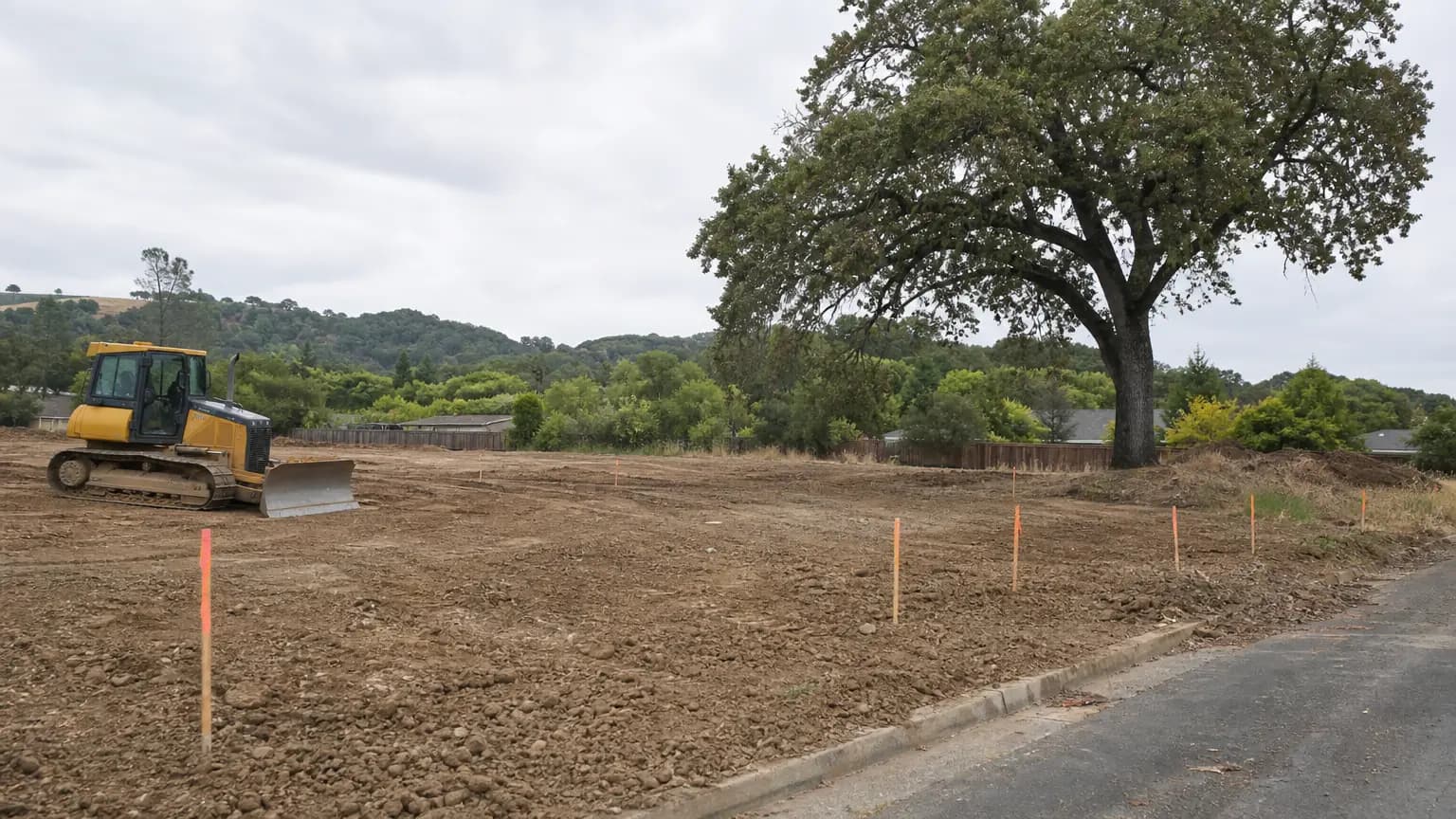
On a quiet stretch of Oak Road in southeast Simi Valley, a stand of valley oaks has shaded the same ground for centuries — surviving Spanish missionaries, American settlers, and wave after wave of suburban development. Red-tailed hawks have circled overhead. Morning glories have bloomed at the trees' roots. But that stillness is now about to end.
On June 8, the Simi Valley City Council unanimously gave initial approval to a 60-unit condominium project that would remove 52 of the 53 mature trees on the site — including valley oaks that opponents say could be among the oldest living things in the city, as the Simi Valley Acorn reported. The vote sets in motion a General Plan amendment and zone change that would reclassify the 5.7-acre property at 1761, 1801 and 1807 Oak Road from moderate- and medium-density residential to high-density residential, with a second reading scheduled for June 22.
A Tree That Predates the Nation
At the heart of the controversy is a single tree: T-1, a valley oak that former Simi Valley Councilmember Barbara Williamson described as a "living treasure" estimated to be roughly 300 years old — meaning it was already mature when George Washington was born and the American Revolution had not yet been imagined. Williamson argued that replacement saplings could not come close to matching its ecological or historical value and would take numerous generations to reach anything like its current stature.
Resident Heather Moss made a similar plea during public comment, arguing that T-1 and a second large oak, identified in project documents as T-41, may be among Simi Valley's oldest living indigenous residents. "They are a living link to our city's past," Moss told the council.
The trees are not just historically significant — they are ecologically vital. Valley oaks support a remarkable web of life, providing habitat for birds, insects, and mammals. Their canopy and root systems help manage stormwater, and their shade cools the surrounding neighborhood. Losing them, opponents say, is a loss that money cannot easily replace.
Yet the developer's arborist found the trees to be below average in health, citing decay, thinning canopy, structural weakness, and root system damage caused by prior development on and around the property. The city's own consulting arborist agreed. Relocation was also ruled out as unlikely to succeed given the trees' root depth and low transplant survival rates.
The Case for Building
Sentry Property Group LLC, the project's developer, has proposed a development that city staff and a council majority ultimately found difficult to refuse. The project includes 57 market-rate condominiums and three very low-income units secured under a 45-year affordability agreement. In exchange for those affordable units, the developer qualified for a state density bonus and four zoning waivers under California law — including reduced setbacks and modified garage requirements.
Applicant representative Sal Provenza was direct about the economic reality: preserving the trees would make the project infeasible. "While we're certainly sympathetic, the trees are located in an urban environment, with T-1 sandwiched between two new housing developments as contemplated by the city's long-term planning documents," Provenza told the council. Fire Department access requirements also played a role — city documents confirm that the private streets needed for the development conflict directly with the locations of three large oaks on the property.
Councilmember Joseph Ayala captured the painful arithmetic many elected officials face in California's housing crisis: "It's an amazing tree, but it's not a healthy tree. For the sake of affordable housing, even though I really wish we could keep the tree, I'm going to support this project."
Resident Michael Shaw echoed the housing argument, saying the project would expand opportunities for first-time homebuyers in a market where owning a home has become increasingly out of reach for many families.
What the City's Rules Allow — and Require
Simi Valley's Mature Tree Preservation Ordinance, which has been in place for decades, requires developers to obtain a Tree Removal Permit before removing any protected tree — and all mature native oak trees are protected under the city's municipal code, according to the City of Simi Valley's planning division. But the ordinance also allows removal when preservation is not practical, and the burden falls on city staff and consulting arborists to make that determination.
In this case, officials said keeping all 53 trees would conflict with grading, drainage, and fire safety requirements — and the removals were determined to comply with the ordinance. The 52 trees to be removed carry an estimated replacement value of $533,329, a sum the developer must either match through new plantings on or near the site or pay into the city's tree fund.
The Planning Commission recommended approval in May on a 3-1 vote, but not without dissent. Commissioner Ken Rice, who cast the lone no vote, said flatly that swapping a centuries-old tree for a sapling was not an adequate trade-off. Planning Chair Lee Kennedy acknowledged the tension, saying the city was balancing housing needs against environmental impacts — a phrase that has become something of a civic mantra in Ventura County as development pressure mounts.
The project also qualified for a statutory exemption from the California Environmental Quality Act under a 2025 state law for urban infill housing, according to state CEQA records, further limiting the scope of environmental review.
Oak Road Is Changing Fast
The Sentry project does not exist in isolation. Oak Road has become a focal point for dense residential development in southeast Simi Valley. Just north of the Sentry site, City Ventures Homebuilding LLC received approval in 2024 for a 70-unit condominium development at 1845 Oak Road — a project that involves removing 35 trees, though none of them oaks. Elsewhere in the city, an industrial project under construction at Tapo Canyon Road and Guardian Street is removing 144 trees, mostly pepper trees, with the developer planning to save one heritage oak.
Taken together, these projects reflect a city under significant pressure to add housing inventory. According to prior Simi Valley Acorn reporting, Simi Valley faces a state mandate to build thousands of new residential units in the current housing cycle — with more than half required to include affordability components. In a city where most available parcels are infill sites nestled into existing neighborhoods, that math increasingly leads developers to lots that haven't been built on precisely because they have something worth protecting.
Councilmember Rocky Rhodes said he appreciated efforts to design around trees where possible and suggested the developer consider relocating additional oaks if feasible — a nod to the fact that the community's grief over this decision is real, even if the council ultimately concluded the project should move forward.
A Small Concession for the Future
One silver lining, if a modest one: the developer agreed to dedicate a 10-foot easement for a future extension of the Arroyo Simi Greenway, the beloved approximately 12-mile trail system that runs east to west across Simi Valley and continues to expand in phases. That easement means the footprint of this development will eventually connect to a broader network of open space — offering at least the possibility that the neighborhood gains something green as it loses something irreplaceable.
For now, the oaks stand. The second council reading was scheduled for June 22. If the vote holds, the chainsaws will follow — and a street named Oak Road will be left to remember what it once sheltered.
Reported by 805.life
Researched and written drawing on primary sources. Additional reporting: Simi Valley Acorn.
City
Simi ValleyAdditional Reporting
Simi Valley AcornPublished
June 19, 2026
Reported and written by 805.life
Explore Simi ValleyAll Simi Valley NewsMore News from Simi Valley
 Simi Valley
Leaders discuss county’s demographic dilemma
Friends, have you noticed it too? Ventura County is changing. We're getting older, fewer babies are being born, and young families—the ones who'd love to put down roots in Simi Valley—are finding it harder and harder to afford life here. That was the big topic at the Ventura County Civic Alliance's Future of the Region Conference in Camarillo on Sept. 14, as the Simi Valley Acorn reported. Leaders gathered to wrestle with what these demographic shifts mean for our workforce, housing, schools and public services down the road. This isn't just an abstract statistic. It's about whether our kids can afford to stay, whether local businesses can find workers, and whether our neighborhoods keep their vibrancy. Worth paying attention to—these decisions will shape Simi Valley for decades.
 Simi Valley
Park board plays out new budget for Simi/Oak Park
Big news for our corner of the 805: the Rancho Simi Recreation and Park District just approved a $70 million budget, and about $20 million of that is going straight into capital improvements. We're talking nearly $7.5 million for Activity Center Phase III and roughly $2.3 million for a new BMX track—projects that'll give Simi Valley and Oak Park families more places to play, gather, and stay active. If you've spent any weekend circling a packed parking lot or waiting on a field, you know how much our parks carry this community. This kind of investment isn't just concrete and dirt—it's birthday parties, after-school practices, and neighbors actually running into neighbors. Shoutout to the Simi Valley Acorn for keeping us posted on the details. Keep an eye on construction timelines, because these upgrades will shape our weekends for years to come.
 Simi Valley
Mayor puts the shine on Simi Valley’s future
Big things are brewing in Simi Valley, and Mayor Dee Dee Cavanaugh laid it all out at the annual State of the City. From a new office to handle the boom in filming around town, to the possibility of 1,000 fresh Pennymac jobs, to whispers of a professional hockey team calling our city home—there's a lot to keep an eye on. The mayor also highlighted a declining crime rate and nearly $28 million in new infrastructure projects, which means safer streets and smoother roads for all of us. As the Simi Valley Acorn reported, these developments could reshape our community in exciting ways. It's the kind of news that makes you proud to live here. Whether you're a longtime resident or new to the 805, these changes touch us all—so stay tuned, neighbors. Simi Valley's future is looking bright.