One Year After the Glass House Raid, California Still Fails Farmworkers
The last message Leticia Cruz Vasquez received from her husband was a text: "Don't worry about me, I'm hiding." She had missed his call because her phone battery had died. By the time she saw the words, Jaime Alanís Garcia — a 56-year-old farmworker who had spent nearly 30 years in the United States quietly building a life, sending money home to his family in Michoacán — had already fallen 30 feet from a greenhouse roof at Glass House Farms in Camarillo, trying to escape masked federal agents. He died two days later, on July 12, 2025, at Ventura County Medical Center. He never spoke to his wife again.
One year later, the region where Jaime worked — and where hundreds of thousands of people like him quietly sustain California's $4.65 billion agricultural economy — is still reckoning with the consequences of what happened on July 10, 2025. The Santa Barbara Independent this week published a sober assessment written by policy analyst Matt Kinsella-Walsh and community advocate Danny Sanchez-Bravo: California has not delivered justice to the workers swept up in the Glass House raid, and the structural conditions that made it possible remain unchanged.
A Day of Chaos on the Central Coast
On the morning of July 10, 2025, hundreds of federal ICE and Border Patrol agents executed criminal search warrants at Glass House Farms' facilities in Camarillo, in Ventura County, and on Casitas Pass Road in Carpinteria, just outside Santa Barbara's southern border. Glass House is one of California's largest legal cannabis producers.
At Carpinteria, agents deployed smoke grenades, flashbang grenades, rubber bullets, and tear gas on hundreds of community members and public officials who had gathered in protest outside the farm. Carpinteria City Councilmember Mónica Solórzano was injured when law enforcement pushed into the crowd and she fell, injuring her right arm. U.S. Congressman Salud Carbajal was denied entry to the farm. Emergency responders struggled to reach the injured: 911 calls released by the Ventura County Fire Authority on the raid's one-year anniversary describe callers being shot by rubber bullets and people trapped in sweltering cars, terrified to move while federal agents surrounded them.
In total, 361 workers were detained, including 14 minors, across both facilities. The Department of Homeland Security issued a press release framing the operation as a rescue mission for child trafficking victims. But DHS has provided no evidence to substantiate its initial claims of child labor, human trafficking, or structural abuse at the facility — and a California Department of Cannabis Control routine site visit in May 2025, just two months before the raid, reported observing zero minors on the premises.
For Jaime Alanís Garcia's family, the federal account of a safety operation rings especially hollow. His wife and daughter have filed a wrongful death lawsuit against both Glass House Farms and the federal government, alleging that agents used excessive force and failed to provide timely medical care, and that Glass House breached its duty to secure the ladders and roofs at the facility. The lawsuit states that agents used rubber bullets, tear gas, and stun guns while "indiscriminately" arresting farmworkers, causing panic and chaos that drove Alanís Garcia to seek shelter on the roof. A year on, his wife says the family is still demanding answers.
A Company's Calculated Response
In the days after the raid, Glass House issued statements shifting responsibility to a third-party labor contractor it had employed at both facilities at the time. According to a Forbes profile of the company published in June 2026, co-founders Graham Farrar and Kyle Kazan said the workers detained were not their direct employees, but contractors — and that their agreements with the firm required everyone on the premises to be at least 21.
Since then, Glass House terminated its relationships with those farm labor contractors and hired compliance firm Guidepost Solutions — led by former ICE Director and Assistant Secretary of Homeland Security Julie Myers Wood — to implement stronger employment eligibility verification procedures. The company confirmed in a public statement that all employees and farm labor are now E-verified. The raid, it noted, cost the company approximately $20 million.
But as the Independent's writers document, none of these measures address what happened to the 361 workers and their families. Glass House had promised to coordinate legal assistance for those detained; it has not followed through on that promise. Meanwhile, the company — which generated $200 million in revenue and $97 million in gross profit in 2024 on the labor of the very workers it now distances itself from — is actively seeking ways to automate its marijuana production to minimize human labor. The Forbes piece adds that Glass House projects up to $245 million in sales by the end of 2026 and recently began trading on the New York Stock Exchange. The workers who built that operation remain largely without recourse.
Fear Has Forced Children Into the Fields
The human cost in the 805 region has compounded in the year since the raid. Primitiva Hernandez, executive director of 805UndocuFund — a nonprofit that has provided legal and financial assistance to many of the detained workers' families — estimates that roughly half of all ICE detentions in the 805 area code have involved farmworkers, the overwhelming majority of whom are Indigenous migrants from Guerrero, Oaxaca, and Puebla.
The numbers have accelerated sharply. According to data from 805UndocuFund cited by the Santa Barbara News-Press, immigrant detentions in Santa Barbara County increased by nearly 700% — with 319 detentions documented between January 1 and May 31, 2026, compared to just 40 during the same period in 2025. The Independent's op-ed authors note that since 2025, 2,153 fathers, mothers, and children have been taken from Ventura and Santa Barbara counties.
Those who have not been detained live in a state of constant anxiety. Many community members live in a perpetual state of stress and avoid leaving the house as much as possible, making it harder to attend school, seek medical care, maintain employment, or participate in community life. The cruel irony, Hernandez told the Independent's authors, is that the fear and loss of household income caused by the raid and ongoing enforcement has forced more children into the fields to support their families — deepening the very cycle of exploitation the raid claimed to end.
The Structural Failure Behind the Headlines
Kinsella-Walsh and Sanchez-Bravo situate the Glass House raid within a broader economic reality that Santa Barbara residents largely don't see: agriculture on the Central Coast is a massive industry built on a workforce it refuses to protect. Ventura and Santa Barbara counties generated $4.65 billion in farm-level agricultural value in 2025 — a figure that doesn't even include revenues from farm labor contractors, cooling centers, or shippers. Against that, farmworkers in those two counties earned a combined $717 million in 2025, at wages well below the local cost of living.
The dominant trade organization for Central Coast growers, the Western Growers Association, supports federal labor policy changes projected to cut farmworkers' annual wages by an additional 10 to 12 percent. Hernandez describes this as simply the norm: "It is just the way the agricultural industry operates in California," she said.
On July 12, 2026 — just days before the formal one-year mark — community members marched through Carpinteria's streets in a four-hour event organized by Carpinteria Sin Fronteras, 805UndocuFund, and SBResiste, featuring Aztec dance, ceremony, speakers, and a march from Linden Avenue to Glass House Farm and back. Marchers carried signs reading "Rest in power Jaime Alanis" and "ICE out of Carp." "What we are seeing today is going to be written in the books of U.S. history," Hernandez told the crowd, according to the Santa Barbara News-Press.
Jaime Alanís Garcia had worked in agriculture in the United States for nearly 30 years. He sent most of his earnings home to his wife and daughter in Michoacán. He returned to Mexico only once during that time — for his daughter's quinceañera. His family described him as a quiet, dutiful man who kept out of trouble. "He's just been working," a family friend told reporters. "That's all he came here to do."
One year after his death, no one has been held accountable. His family is still waiting for answers. And the farmworking communities of the Central Coast — the people who pick and tend and harvest the crops that define this region — are still waiting for something more than grief.
Reported by 805.life
Researched and written drawing on primary sources. Additional reporting: Santa Barbara Independent.
City
Santa BarbaraAdditional Reporting
Santa Barbara IndependentPublished
July 15, 2026
Reported and written by 805.life
Explore Santa BarbaraAll Santa Barbara NewsMore News from Santa Barbara
 Santa Barbara
Great California ShakeOut: Cal OES Shares Earthquake Safety Tips for Central Coast Residents
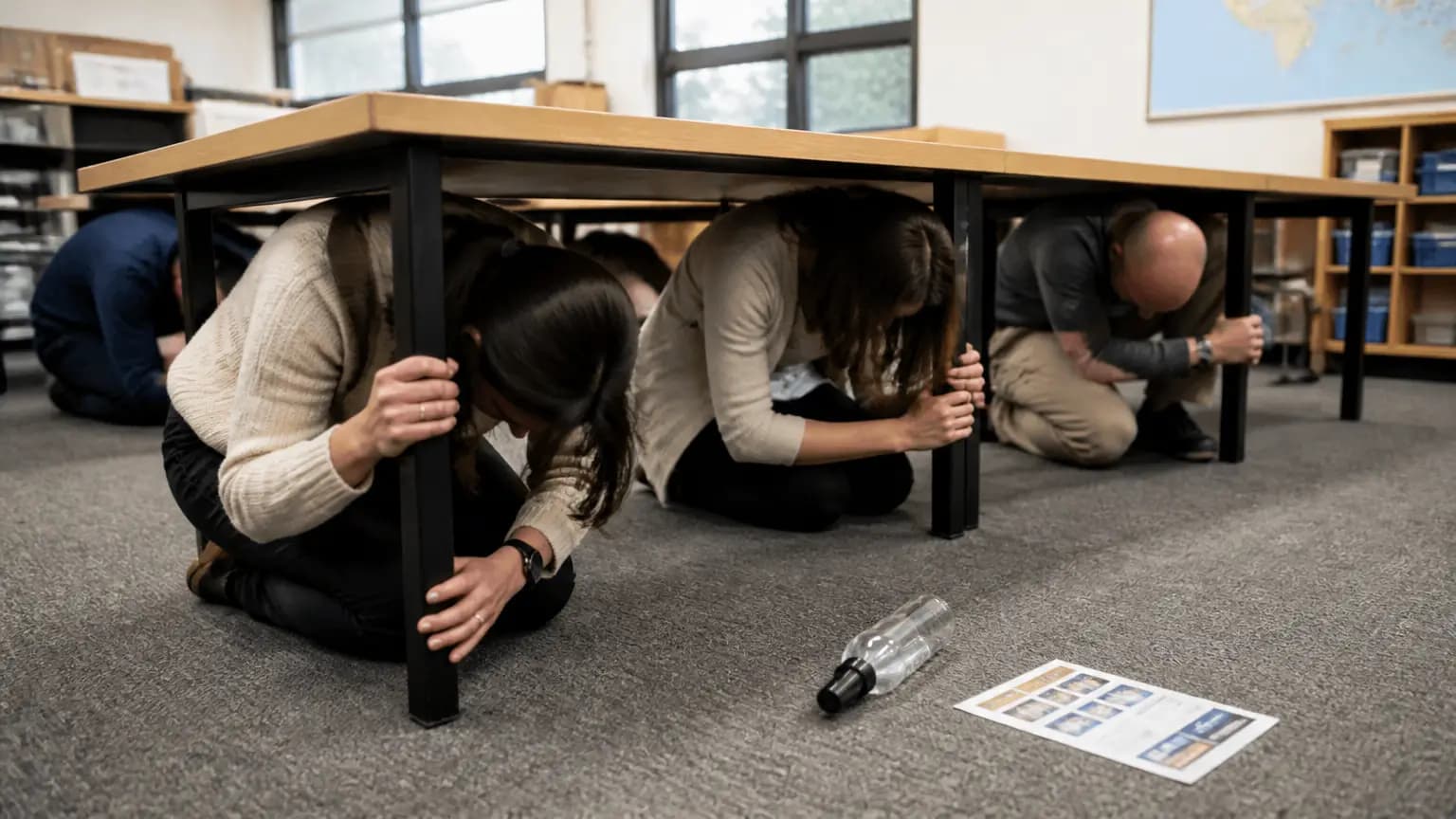
Santa Barbara folks, Thursday is the Great California ShakeOut, and Cal OES is using it to remind us of a few things we might have learned wrong the first time. Forget the doorway — that old advice is outdated. Drop, cover, and hold on under a sturdy table is still the move, and if you're near the coast when the shaking stops, don't wait for an official warning before heading to higher ground. Here in the 805, we live with the reality of the fault lines under our feet and the ocean at our doorstep, so this drill isn't just a box to check. KEYT News Channel 3-12 shared the tips, and they're worth a minute of your time before Thursday. Talk with your family about where you'd meet and how you'd get to higher ground — because in a real quake, those few seconds of muscle memory matter.
 Santa Barbara
GauchoFest Invites Community to Campus for Day of Celebration
Here's a rare chance to enjoy everything we love about UCSB without needing a student ID or a parking miracle. GauchoFest takes over Commencement Green on Saturday, Oct. 17, from 1 to 6 p.m., and the whole 805 is invited — not just alumni, but neighbors, families and anyone curious about the campus in our backyard. Expect live music, games and plenty of photo-worthy moments, all wrapped in that easygoing Goleta afternoon glow. It's a lovely reminder that our universities aren't walled off from community life; they're part of what makes this stretch of coastline special. Big thanks to Noozhawk for the heads-up on this one. So grab a blanket, round up the crew and head to campus. Whether you bleed blue and gold or just love a good fall Saturday, this is one celebration worth showing up for.
 Santa Barbara
Santa Barbara City College to Host 2026 SBCC Trustee Candidate Forum
If you've got a stake in our local community college — and honestly, most of us in Santa Barbara do — mark your calendar. SBCC is hosting the 2026 Trustee Candidate Forum, giving voters a chance to hear directly from the people hoping to help steer the college through its next chapter. SBCC is one of our region's true anchors, from transfer students heading to four-year schools to career training and lifelong-learning classes many of us have taken ourselves. The Board of Trustees makes the calls on budgets, programs and priorities, so who sits on it matters more than a lot of folks realize. Hats off to the Santa Barbara Independent for keeping this on the radar. Show up, ask a question, and get to know the names on your ballot before you vote.