Solvang officials submit to new financial reporting after phone app backlash
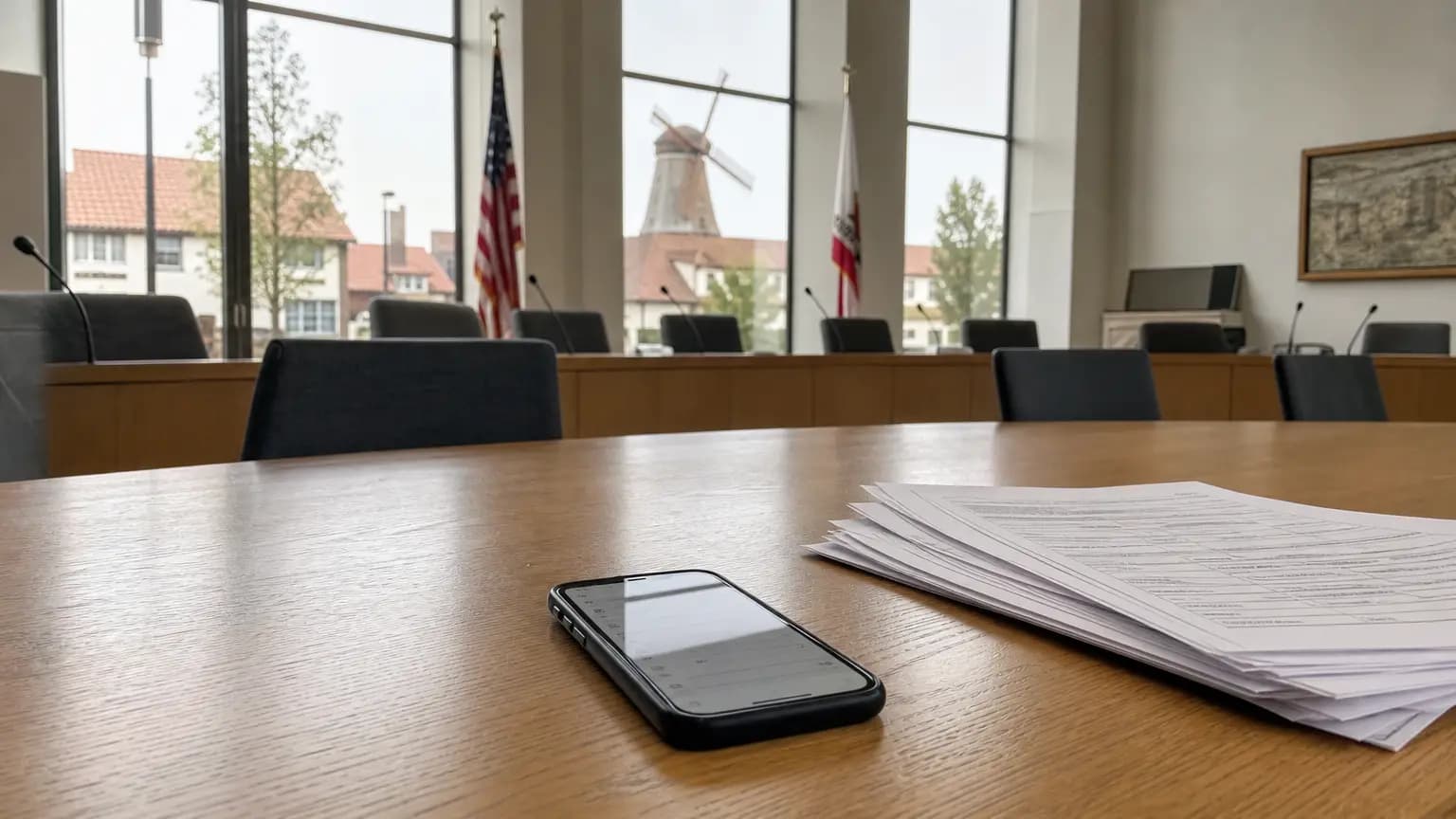
A months-long controversy over a tourism phone app created by Solvang's own mayor has forced the Santa Barbara County city to overhaul how its elected officials report their financial interests — and raised pointed questions about transparency that resonate across the 805 region.
What Changed, and Why It Matters
The Solvang City Council voted 4-1 on June 8 to amend its ethics code, establishing new, mandatory financial-disclosure rules for all sitting council members, as first reported by the Santa Maria Sun. Under the revised code, the city manager is now required to periodically prepare staff reports compiling each council member's financial interests and Form 700 filings — the state-mandated disclosure documents that California public officials must file with the Fair Political Practices Commission (FPPC). Council members must also self-report any new financial interest to the city manager within 30 days of acquiring it, and those new interests will then be shared with the full council on a quarterly basis.
The trigger for all of it: Solvang Passport, a mobile phone app created and owned by Mayor David Brown that promotes select tourism destinations and businesses in the Danish-themed town for a monthly subscription fee — a private, for-profit side venture run by the city's top elected official.
How the Controversy Unfolded
Brown notified City Attorney Chelsea O'Sullivan and City Manager Randy Murphy about Solvang Passport in late 2025, seeking advice on potential conflicts of interest. But under the city's existing municipal code, staff had no obligation to relay that disclosure to the rest of the council — and they didn't. The Santa Maria Sun reported that Murphy acknowledged, "I didn't say anything because there was nothing in the code that says, 'Hey, you all should know or have an opportunity to weigh in on it.'" Murphy and O'Sullivan reviewed the app through the narrower lens of state conflict-of-interest rules, rather than how the council or the public might perceive it.
The app came to public light on Feb. 23, when the owner of the Solvang Skate Shop, Robert Hargreaves, addressed the council during open public comment — saying he'd learned about the app earlier that same day. Councilmember Louise Smith later said she felt "blindsided" upon learning about the app in March, and council members directed staff to investigate potential conflict-of-interest concerns at a March 9 meeting.
Further complicating matters, Councilmember Elizabeth Orona alleged that the city's tourism website "was scraped to create a separate private entity app" and that city-funded text remains on the app. Brown denied the app used city assets. At a March 23 meeting, O'Sullivan reported that an audit of the app did find at least one segment from a city-produced source, though the full scope of that finding was not detailed in public records reviewed for this story.
The app is designed so that businesses pay $249 per month to be featured, though Brown has said participation has so far been free. Visitors can earn points and redeem rewards at participating locations, including perks like a free ice cream cone at the Solvang Trolley Ice Cream Parlor — a business owned by the family of Councilmember Claudia Orona.
The Vote and Its Dissenters
The council's April 27 session saw staff pitch a single-sentence addition to the ethics code requiring council members to "promptly notify staff and the City Council of any new material financial interests." But council members said the language was too vague, and sent staff back to refine the proposal. The June 8 amendment reflects that more specific, 30-day timeline approach.
Brown was the lone vote against the measure. "I'm not seeing how putting it in front of everybody every six months improves the situation," he said at the meeting, adding that he felt the new self-reporting requirement was redundant with rules already in place under the FPPC. O'Sullivan acknowledged the overlap — noting that Form 700s are already public documents anyone can look up — but said the new policy was "more about affirmatively getting the information in front of the council" at a more frequent pace.
Claudia Orona, whose family's ice cream business is listed on the Passport app, voted yes — but with hesitation. "I hope I don't regret this," she said before casting her vote. She warned that while she supported the intent, the new powers could someday be misused: "I could see how this could get abused to just target or bully a colleague, just because we don't like them or we don't like their opinions."
The Santa Barbara News-Press reported that the June 8 amendments also gave council members the ability to censure one another — a significant new internal accountability tool — and included a provision that violations of state or federal law be referred to the appropriate enforcement agency, per the Santa Maria Times.
Tourism Money and Political Stakes
The stakes in Solvang are unusually high when any tourism-related policy is in play. About 84% of Solvang's annual tax revenue — more than $9 million — comes from hotel occupancy and sales taxes, and the city is proposing to spend $1.1 million on visitor-focused marketing and activities in its fiscal year 2026-27 budget. That makes any private venture that intersects with official tourism promotion an inherently sensitive matter for local governance.
After the vote, Brown signaled he may restructure his involvement in Solvang Passport — potentially licensing the app to another entity and possibly expanding the model to other tourist destinations, such as Pismo Beach or the Funk Zone in Santa Barbara. Brown's mayoral term runs through December 2026, according to the City of Solvang's website.
What Comes Next
The amended ethics code is now in effect, requiring the city manager to begin compiling and presenting council members' financial disclosures on a regular schedule. For residents across the 805, the Solvang case offers a concrete illustration of how gaps in local transparency rules can let politically sensitive business arrangements develop in plain sight — and how community pressure, starting with a single public comment at a February council meeting, can drive policy change.
Anyone wishing to review Solvang council members' existing Form 700 filings can do so through the FPPC's public financial disclosure portal, which allows free online searches of financial interests disclosed by elected officials statewide.
Reported by 805.life
Researched and written drawing on primary sources. Additional reporting: Santa Maria Sun.
City
Santa MariaAdditional Reporting
Santa Maria SunPublished
June 18, 2026
Reported and written by 805.life
Explore Santa MariaAll Santa Maria NewsMore News from Santa Maria
 Santa Maria
No deal: Solvang staffers strike after rejecting City Council’s ‘last, best, and final’ pay raise offer
Solvang city workers made history this month — and not the charming Danish-village kind. About 30 unionized employees, including engineering technician Cole Phillips, walked off the job Sept. 15 after rejecting the City Council's "last, best, and final" pay offer. It's the first labor strike in Solvang's history, and it's a big deal for a small town where city staff keep the wheels turning. For those of us here in Santa Maria and across the 805, this is a reminder that the folks behind the counter at city hall, fixing our streets, and processing our permits are neighbors with bills to pay. When a city and its workers can't agree, residents feel it too — in slower services and a workforce that feels undervalued. The Santa Maria Sun has been following the standoff closely. Wherever you land on the politics, it's worth watching how this plays out up the valley. Small-town labor fights don't stay small for long.
 Santa Maria
Tie vote blocks Lompoc from censuring Steve Bridge
Lompoc's city council spent three hours on Sept. 15 wrestling with whether to censure one of their own, Councilmember Steve Bridge — and in the end, a tie vote meant the censure failed. Bridge's own appeal to the room was simple: remember the oath everyone stands and recites before every agenda, the same words our kids learn in kindergarten. Censure is a symbolic move, but symbols matter in small-town politics. It's the council's way of saying a colleague crossed a line, even when there's no formal punishment attached. A tie means half the dais wasn't willing to go there, and that split says as much about Lompoc's leadership as any resolution could. The Santa Maria Sun has the full account of that long meeting. For those of us up and down the 805, it's a reminder to keep an eye on our own councils — the local decisions that shape our towns often get decided by a single vote.
 Santa Maria
Santa Maria denies movie theater alcohol sales
Santa Maria moviegoers hoping to pair a cold one with their blockbuster will have to keep waiting. On Sept. 16, city planning commissioners turned down a proposal that would have let local theaters sell alcohol, making us the holdout while 55 other Regal cinemas across California already pour drinks alongside the popcorn. Commissioner Tim and others gave it a fair look, weighing the possible boost to our local cinema scene against the concerns that come with mixing booze and a dark room full of strangers. It's a very Santa Maria debate, honestly — we tend to be cautious about change, and that's not always a bad thing. The Santa Maria Sun first reported the decision, and it's worth a read if you want the full back-and-forth. So for now, it's soda and candy at the concession stand. Whether that keeps our theaters family-friendly or just keeps them losing ground to Atascadero and SLO, only time will tell. What do you think, neighbors?