Updated Flood Hazard Maps Go Into Effect in Santa Barbara County
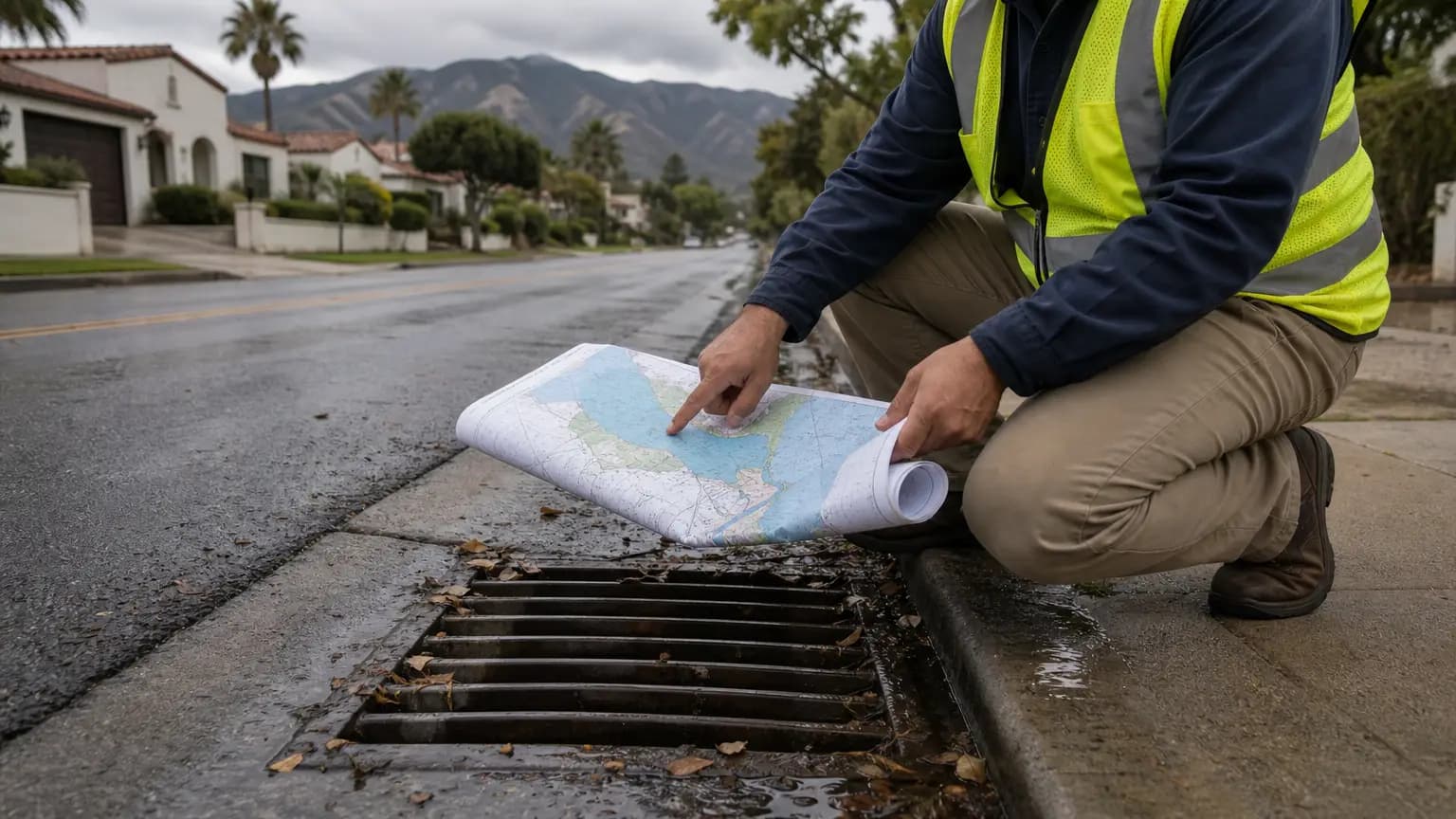
After nearly a decade of outdated charts and almost eight years of post-disaster recovery maps, Santa Barbara County entered a new era of flood-risk management on June 10, 2026, when the Federal Emergency Management Agency's freshly revised Flood Insurance Rate Maps (FIRMs) became the law of the land. The change affects homeowners, developers, and local governments from the Ventura County line all the way up to the Santa Ynez Valley — and it carries real financial and regulatory consequences for thousands of properties.
What Changed and When
According to the City of Santa Barbara's official FEMA Mapping page, FEMA issued its Letter of Final Determination for the city on December 10, 2025, setting June 10, 2026 as the effective date for the new maps. On that date, the older maps were rescinded and the county began relying solely on the updated FIRMs, as the Santa Barbara Independent reported.
The new maps replace charts that Santa Barbara County had been using for roughly 10 years, according to Noozhawk. They cover a broad swath of the region: FEMA revised the Special Flood Hazard Area maps for parts of Santa Barbara County including the City of Santa Barbara, Montecito, Carpinteria, Buellton, Solvang, and Santa Ynez, a county fact sheet confirmed.
The maps themselves have been years in the making. FEMA first issued the preliminary FIRMs on March 26, 2024, and updated them on May 15, 2025, before they were formally adopted. The county did not wait passively: on July 15, 2025, the Board of Supervisors — also acting as the Flood Control and Water Conservation District Board — approved a recommendation from the Floodplain Administrator to incorporate the preliminary FIRMs into the county's official flood hazard maps, edhat reported. During the intervening months, the county applied the preliminary maps alongside FEMA's then-current effective maps until FEMA made them official this month.
The Shadow of Montecito's 1/9 Debris Flows
For longtime Santa Barbara County residents, the timeline of these maps is inseparable from one of the region's worst natural disasters. On January 9, 2018 — just weeks after the Thomas Fire scorched the mountains above — a catastrophic debris flow swept through Montecito, killing 23 people and damaging or destroying hundreds of homes. U.S. Highway 101 was closed through the community for roughly two weeks.
The disaster left the landscape fundamentally altered. Creek channels and land elevations changed throughout the debris flow area, rendering existing FEMA flood maps inaccurate. FEMA moved quickly in response: a recovery map was created within five months of the catastrophic debris flow — a record turnaround for FEMA — and it represented a major expansion of the flood plain in Montecito and the Carpinteria Valley, edhat reported at the time.
Those interim advisory flood maps had been in use since June 19, 2018. For nearly eight years, the Board of Supervisors and county planners relied on them to develop new building regulations and guide the post-disaster recovery. The new permanent FIRMs now replace those interim charts entirely.
The new maps were built with significantly more sophisticated tools. The updated maps were created using new technology to more accurately capture the topography of the region and how it has changed over the years, Noozhawk reported. That matters especially in Montecito, where years of storms since 1/9 have continued to shift creek beds, deposit sediment, and reshape the alluvial fans on which much of the community is built.
Who Is Affected — and How
The picture is mixed for property owners. Some will see relief; others will face new requirements. County spokesman Lael Wageneck summed it up plainly: "While some properties will see reduced requirements under the new maps, many projects will continue to require oversight," he told Noozhawk.
The areas most likely to see changes are the eastern portion of the city of Santa Barbara to the Ventura County line, along with some portions of the Santa Ynez Valley. Some property owners who were previously outside a flood zone may now find themselves inside one. Parts of Montecito are a prime example — the changed landscape after the 2018 debris flows means risk profiles have shifted considerably.
For development, the rules still carry significant weight. Projects near streams or rivers, within building setbacks, inside FEMA's newly mapped Special Flood Hazard Areas, or in the Repetitive Loss Zone will still require Flood Control District oversight. Larger or more complex projects — such as subdivisions, discretionary permits, or commercial development — must continue to meet standard conditions, the Independent reported.
On the relief side, county residents who own property in a former Recovery Map High Hazard Area may no longer need permitting review from the Flood Control District, a significant reduction in regulatory burden for some Montecito and Carpinteria landowners who had been living under the expanded post-disaster flood zone for years.
What Flood Insurance Means for Your Wallet
For most homeowners, the most immediate practical impact will be on flood insurance premiums. The new FIRMs are used directly by FEMA's National Flood Insurance Program (NFIP) to set coverage requirements and influence rates. The NFIP makes flood insurance available to residents, makes the city eligible for pre-disaster grants, and makes the city eligible for disaster relief assistance, according to the city's official FEMA mapping page.
For residents who find themselves newly inside a Special Flood Hazard Area, mandatory flood insurance coverage may now apply — particularly for properties with federally backed mortgages. Standard homeowners' insurance may not cover flood damage, and new NFIP policies require a 30-day waiting period before taking effect, the Independent cautioned. That means Santa Barbara-area homeowners should not wait until a storm is in the forecast to start the coverage conversation with their insurer.
What Residents Should Do Next
Residents can check whether their property is in a Special Flood Hazard Area — or has moved out of one — using the City of Santa Barbara's Interactive Flood Hazard Map for properties within city limits. For unincorporated county areas, the Santa Barbara County Flood Control District maintains its own mapping resources.
For questions about flood insurance, FEMA directs residents to floodsmart.gov. The Santa Barbara County Flood Control District can also be reached by phone at 805-568-3440 or by email at [email protected].
With another La Niña transition possible in the coming months and the region's history of atmospheric rivers and post-fire debris events, the stakes for getting flood-risk information right have never been higher on the Central Coast.
Reported by 805.life
Researched and written drawing on primary sources. Additional reporting: Noozhawk.
City
Santa BarbaraAdditional Reporting
NoozhawkPublished
June 15, 2026
Reported and written by 805.life
Explore Santa BarbaraAll Santa Barbara NewsMore News from Santa Barbara
Al no haber arma homicida, el juicio contra Caleb Flynn se centra en la relación extramatrimonial y en el supuesto intruso
A murder trial unfolding just up the coast is drawing attention here in Santa Barbara, and it's the kind of case that's hard to look away from. Caleb Flynn's trial, reported by KEYT News Channel 3-12, has no murder weapon — instead, prosecutors are leaning on testimony about a secret church affair, thousands of deleted texts, and lies told to the FBI. Even the family dogs stayed eerily quiet that night, which has become a strange piece of the puzzle. For those of us in the 805, it's a reminder that even tight-knit communities aren't immune to the kind of drama you'd expect from a courtroom thriller. Cases like this can shake faith in neighbors and institutions, and they raise hard questions about trust and evidence. We'll be watching how the trial unfolds — not out of spectacle, but because it touches on the real lives of people not so far from home.
UCSB Recovers From Slow Start, Beats CS Northridge in Big West Volleyball Opener
Good news for Gaucho fans — UCSB women's volleyball finally got back in the win column Friday night at the Thunderdome, shaking off a slow start to beat Cal State Northridge in the Big West opener. After dropping the first set, the team looked like a squad still finding its footing following a tough preseason that ended on a six-match skid. But conference play is a fresh slate, and the Gauchos took advantage. For our Isla Vista and Goleta neighbors, there's something special about catching a match on campus — cheap tickets, loud student section, and a team that's easy to root for. Thanks to Noozhawk for the coverage. If you haven't been to a UCSB volleyball match yet, consider this your sign to check one out this season.
Cottage Health Hosts Sepsis Conference Focused on Early Recognition and Treatment
Cottage Health pulled together doctors, nurses, pharmacists, respiratory therapists and other clinicians from across the region on Friday, Sept. 18, for a conference zeroing in on one of medicine's trickiest foes: sepsis. If you've never heard the word, you're not alone — but it's a leading cause of death in hospitals, and the difference between a good outcome and a tragic one often comes down to how fast someone recognizes the signs. That's why this gathering matters here. Santa Barbara County spans a big, sometimes rural region, and not every clinic or ER has the same resources. When Cottage Health convenes providers from up and down the 805 to share protocols and lessons learned, it quietly raises the standard of care for all of us — whether you're in Goleta, Lompoc, Santa Maria or Santa Ynez. The Santa Barbara Independent first reported the conference, and it's the kind of unglamorous, behind-the-scenes work that keeps our community healthier. Next time you or a loved one lands in an ER with a puzzling fever, this is the preparation you'll be glad happened.